Why Vietnamese Tones Feel Hard Even When You Know the Words
Vocabulary can be solid while tones still fail. Recording check, one phrase, one correction—without fake fluency guarantees.
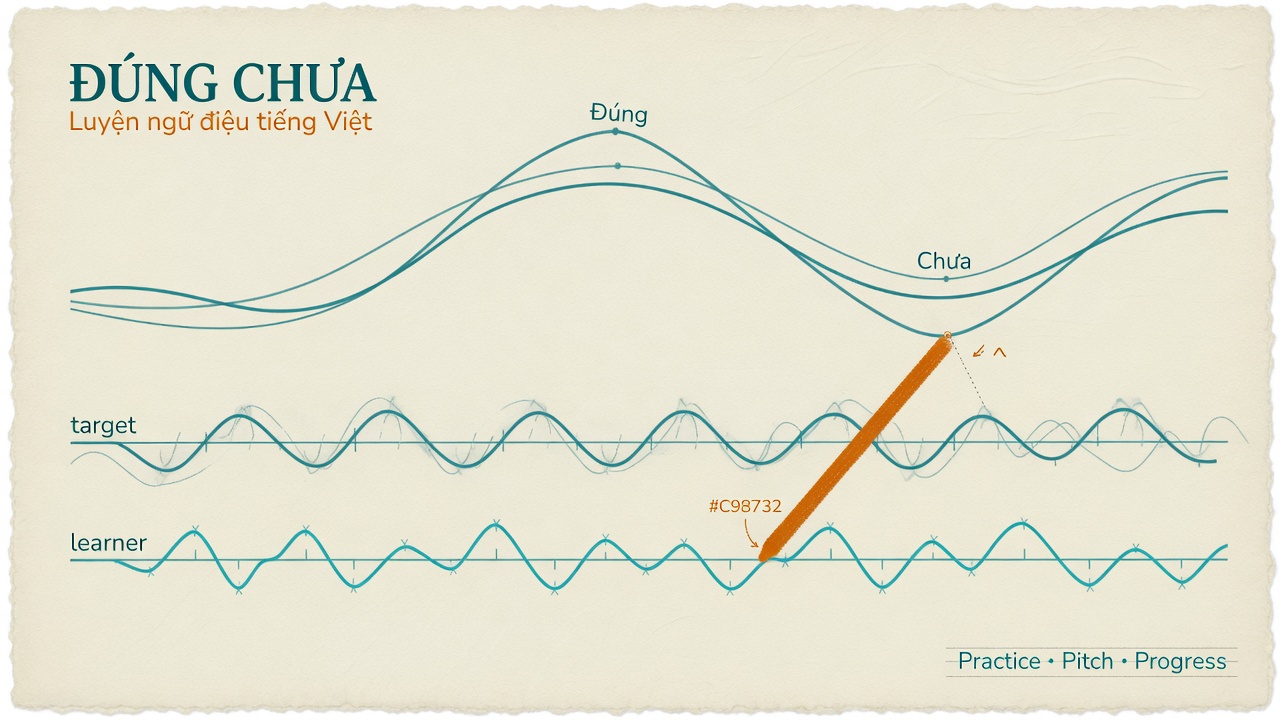
Knowing the Words Is Not the Same as Hearing the Tones
If you have studied Vietnamese vocabulary and grammar, you have likely hit a strange wall. You can read the sentences, you know what each word means, and you can even write the diacritics correctly. But when you speak, the tones come out flat, or wrong, or somehow both at once. The words are in your head, yet your voice refuses to produce the pitch movements that make them recognizable to a Vietnamese speaker.
The words are in your head, yet your voice refuses to produce the pitch movements that make them recognizable to a Vietnamese speaker.
This disconnect is not a failure of memory. Vocabulary knowledge is declarative - it is the kind of knowing that lets you recall that ma with a level tone means "ghost" while má with a rising tone means "cheek." Tone production is procedural. It requires your ear to hear a pitch contour and your voice to reproduce it in real time, against a target that exists only as a movement, not as a fixed note.
The core problem is that tones are relative pitch movements, not absolute pitches. A rising tone in Vietnamese does not start at a specific frequency and end at another specific frequency. It starts wherever your comfortable speaking range happens to be and moves upward from there. This means you cannot memorize tones the way you memorize vocabulary. You need a target contour to compare against - something that shows you the shape of the movement, not just a description of it.
This is where many practice methods fall short. They give you the words, sometimes even the audio, but they never force you to produce the tone first and then compare your production against the target. Without that comparison, you are practicing blind. You repeat the word, hear yourself say it, and have no idea whether your pitch actually moved the way it should have.
A recording check changes this. When you record yourself before receiving any feedback, you are forced to commit to a production. Then, when you compare your recording against the target contour, the difference can become audible - not as a vague sense of "something was off," but as a specific moment where your pitch went up when it should have gone down, or stayed flat when it should have risen.
The mechanism is designed to make the implicit explicit. You are less likely to be guessing whether your tone was correct. You are hearing your own pitch movement side by side with the target movement, and the gap between them can be the information you need to adjust. One phrase, one correction - this keeps the cognitive load low enough that you can actually process the comparison. If you try to correct five tones at once, your ear and your voice cannot track which adjustment fixed which error. With one phrase, the cause and effect are clearer.
The quiet-room scope matters for the same reason. Background noise, music, or conversation does not just distract you - it can mask the pitch information you are trying to hear. If you cannot clearly hear your own recording, you cannot compare it against the target. A quiet room is not a luxury; it is a precondition for the mechanism to work at all.
What Generic Apps and Static Guides Miss
Many language apps treat tones as just another vocabulary feature. Duolingo and LingoDeer, for example, include tone-related exercises in their Vietnamese courses, but those exercises are typically scored as part of a larger lesson that also covers vocabulary, grammar, and sentence structure. The feedback you get is often about whether you selected the right answer or matched the right audio clip - not about whether your own voice produced the correct pitch contour.
Streak gamification compounds the problem. A streak rewards you for showing up and completing activities, which is a measure of activity, not of tone accuracy. You can maintain a long streak while producing the same incorrect tone shape every single day. The app tells you that you are progressing because you are consistent, but consistency without feedback on the thing you are trying to improve is just repetition of the same error.
Static guides and video walkthroughs have a different gap. They show you the tone contours - often with helpful diagrams of pitch movement over time - and they give you audio examples. But they stop at demonstration. You can watch a video of someone producing the six tones, listen to the audio, and still have no idea whether your own production matches. There is no loop. You cannot record yourself, play it back against the target, and get a correction. The information flows one way: from the guide to you. Your own voice never enters the comparison.
The gap that both approaches share is the absence of a live recording-check loop. Generic apps often measure your recognition of tones, not your production of them. Static guides show you what the tones should sound like but never let you hear your own attempt against the target. Neither gives you the one thing that can build ear-voice calibration: a real-time comparison of your recorded pitch against a target contour, followed by a single, specific correction.
This is not a minor feature difference. It is a difference in practice approach. Recognition and production are different skills, and they can be trained differently. Recognition can be built with flashcards and matching exercises. Production requires a feedback loop that generic apps and static guides often omit.
What We Can and Can't Claim About Tone Practice
It is worth being precise about what the recording-check mechanism can and cannot do, because the difference matters for how you should think about your own practice.
What the mechanism can do is give you information. When you record yourself and compare against a target contour, you can learn something specific about your production that you did not know before. You might discover that your falling tone does not actually fall, or that your rising tone starts too high and therefore has nowhere to go. That information is real, and it is the necessary input for correction. The mechanism can help you hear and correct tone contrasts, because it makes the contrast between your production and the target audible.
What the mechanism cannot do is guarantee fluency, eliminate your accent, or make you sound like a native speaker. Those outcomes depend on many factors beyond tone production - including vocabulary depth, grammar automation, listening speed, and the specific dialect you are targeting. No practice tool we know of can promise them, and any tool that does is overstating its evidence.
The mechanism is a tool for calibration, not a promise of perfection.
The evidence boundary here is important. This article describes a mechanism and a design principle. It does not cite studies, because we do not cite internal metrics or published research. What exists is the mechanism itself: recording before feedback, one phrase, one correction, quiet-room scope. You can evaluate whether that mechanism makes sense for your own situation, but you should not expect a guarantee.
The honest claim is narrower and more useful: the recording-check loop can help you hear and correct tone contrasts, because it gives you the comparison that other methods omit. Whether that help translates into fluent speech depends on your broader practice, your goals, and the dialect you are learning. The mechanism is a tool for calibration, not a promise of perfection.
A Founder's Stuck Point: You Know the Words, But Tones Still Feel Hard
Consider a hypothetical founder who has been learning Vietnamese for about a year. She can read news articles, hold written conversations, and understand most of what she hears in podcasts. Her vocabulary is solid and her grammar is functional. But when she speaks, Vietnamese speakers sometimes ask her to repeat herself, and she cannot figure out why.
She has tried the popular apps. She maintained a streak for months, completing tone exercises alongside vocabulary lessons. The app told her she was doing well. But when she recorded herself speaking, she could hear that something was wrong - she just could not identify what. The tones sounded flat to her, but she was not sure which ones were wrong or how to fix them.
She has also watched the YouTube guides. She saw the diagrams of pitch contours, listened to the audio examples, and understood the theory of the six tones. But understanding the theory did not change her production. She could describe the difference between a rising tone and a falling-rising tone, but she could not hear whether her own voice was producing either one correctly.
Then she tried a different approach. She picked one phrase, recorded herself saying it, and played it back against a target recording. The difference was immediately audible: her tone stayed flat where the target rose. She got one correction - not a list of everything wrong with her pronunciation, but a single, specific note about that one phrase. She repeated the phrase, recorded again, and heard the improvement.
The difference was not that she suddenly knew more vocabulary or understood grammar better. It was that she finally had a way to hear her own errors. The recording check gave her the comparison that the apps and the videos never did. One phrase, one correction, in a quiet room - the loop was small enough that she could actually process the feedback and adjust.
This scenario is illustrative, not a case study. It is a hypothetical example designed to show how the mechanism addresses the specific stuck point of a learner who knows the words but cannot produce the tones. It does not prove that the recording-check loop works for everyone, and it does not claim a specific rate of improvement. The problem was never knowledge. It was the absence of a feedback loop that made her own pitch errors audible.
A Route That Respects the Evidence
If you are stuck at the stage where you know the words but the tones still feel hard, the question is not whether you need more vocabulary or more grammar. It is whether you have a way to hear your own errors and correct them one at a time.
The recording-check loop - record before feedback, one phrase, one correction, quiet-room scope - is a design that respects the evidence. It offers something more concrete: a way to compare your production against a target contour and get a single, specific correction you can act on.
You can test this mechanism yourself. Pick one phrase, find a quiet room, record yourself, and compare your pitch movement against a target recording. You may be able to hear the difference. You may find that one correction is enough to change your next attempt. The loop is small, but it can be a missing piece that generic app streaks and static guides do not provide.
If you want to explore how this recording-check loop works in practice, continue on the product route. It is an invitation to test the mechanism, not a guarantee of outcomes. The evidence for the approach is the mechanism itself - and one way to evaluate it is to try it.
Hearing your own pitch against a target is one stuck point. A different essay covers the other failure: why tone practice should refuse a score when the recording is bad, instead of treating a word-recognition checkmark as tone feedback.
If you want early access to Vietnamese tone practice with a recording check before tone feedback—one phrase, one correction, quiet-room first—join the waitlist on dungchua.app.