Hear the Miss Before Anyone Else Does
Quiet-room tone practice starts when you hear your own miss — before the street does.

A phone rests on a wooden desk, screen dark. A thumb hovers over the record button. The room is quiet enough to hear the hum of the refrigerator in the next room. This is not a performance. It is a diagnostic: a chance to hear what other people already hear when you speak.
Why the Street Is the Only Honest Test Room
The street does not care about your confidence. It cares only about whether the tone contour matches the word you intend to speak. When you order coffee in Hanoi or ask for directions in Ho Chi Minh City, you are entering a high-noise environment where every syllable competes with motorbike engines, clattering cups, and overlapping conversations. In that chaos, listeners rely heavily on context clues to guess your meaning. They nod when they think they understand. They hand you the wrong drink when they mishear a tone. They switch to English when the gap becomes too wide to bridge with guesswork.
You carry a belief into these interactions that has kept you safe but stagnant. You believe that speed and confidence can mask a wrong tone. This belief feels true because it has been rewarded by polite strangers who do not want to embarrass you.
People nod.
People hand you the drink.
People guess.
The survival of this belief depends entirely on those nods. But look closely at what those nods cost. A guessed answer is not understanding. A barista reaching for the wrong size is not comprehension. A friend switching to English is not a compliment to your fluency. The belief that speed and confidence can carry a wrong tone fails quietly, in the exact moments you actually care about. Those small, real exchanges are where you wanted to be understood, not decoded.
The harder problem is that the failure is invisible to you first. You cannot hear your own miss in the moment, because your inner ear has already approved the sentence before your mouth finishes it. Your teacher hears it. Your neighbor hears it. The stranger at the bánh mì counter hears it. Everyone hears the gap except the person who could fix it. So the work is not more vocabulary, and it is not another streak. The work is hearing the miss before anyone else does. This requires moving the diagnostic out of the noisy street and into a controlled space where the signal is clean.
How the Quiet-Room Sequence Actually Works
Here is the strange part: when you say a tone wrong, you usually do not hear it as wrong. You hear your own voice from the inside, where the intention is correct. In your head, you aimed for a clear rise, so that is what you believe came out. The listener, hearing you from the outside, receives something else entirely. They receive a flat line where a rise should be, or a dip where the pitch should have stayed level. Two different versions of the same sentence exist simultaneously, and only one of them matches what you meant.
Bone conduction makes this worse. Your jaw and skull carry your voice to your inner ear before the air ever does. This is why a recording of yourself sounds oddly thin and unfamiliar the first time you play it back. The version of your voice you know best is not the version other people hear. For tone languages, that gap matters more than almost anywhere else, because pitch is not decoration. It is the difference between one word and a completely different word.
Then the street adds its own layer of distortion. A café has hiss and clatter. A motorbike passes mid-sentence. The listener has no clean signal to work from, so they lean hard on the tone contour you produced. If the contour is off, they guess. Sometimes they guess right from context. Sometimes they laugh, repeat another word back at you, and you spend the rest of the exchange unsure which syllable betrayed you. None of this means your ear is broken. It means your ear has been reporting on a signal you cannot properly inspect while speaking. That is the mechanism of the miss. Intention, self-perception, and actual output drift apart, and the drift is invisible from the inside. To catch it, you need to step outside your own skull.
The quiet room is not a luxury. It is the listening condition where the gap between what you meant and what you said can actually show itself to you. The sequence relies on five beats. Each one breaks a different part of the silent-error loop.
First, lock the dialect. Vietnamese has regional variations that can confuse learners. By explicitly choosing Northern Vietnamese as your working dialect, you eliminate ambiguity. Every comparison afterward is against one target and not a blur of accents. This lets you build a precise model of the pitch shapes without competing standards.
Second, hear a labeled reference before speaking. Most learners skip this step and jump straight to production. That is a mistake. Your ear needs a target before your mouth can aim. A clear, labeled reference shows the shape you are matching. Without that anchor, you are guessing at pitch rather than aiming at a contour.
Third, make exactly one recording. One take. No retakes before you listen. This forces honesty. When you allow multiple attempts first, you rehearse until you get lucky. One recording captures your current state — what you actually produce, not what you hope you produce.
Fourth, play it back and hear the gap. This is the diagnostic core. Compare the labeled reference against your own recording. Listen for where your voice bends differently from the label you intended. The gap becomes audible here. That recognition is where learning begins.
Fifth, attach one physical cue. A single concrete body anchor helps close the gap on the next attempt. Pitch is abstract. Movement is concrete. Associating a tone with a gesture gives your body a shortcut to the correct shape.
What Generic Tone Advice Leaves Out
Search for tone advice and you will find plenty of it. Pages explain that Vietnamese has six tones. They detail how the ngã differs from the hỏi. They argue that Northern Vietnamese is the reference variety. All of that is true, and all of it is about the language in the abstract. What those pages skip is you.
The public alternative describes the tones. It rarely asks you to record your own voice and compare. That step is where the quiet-room method does its work, because a tone miss is easy to hear in someone else and very hard to hear in yourself. You speak, your own voice masks the error, and the sentence feels right even when it lands wrong on a café counter. A labeled reference recording breaks that spell. You play the label, play your recording, and the gap becomes something you notice rather than something a patient stranger corrects for the third time.
There is another skip worth naming honestly. Much public material treats tone as a theory topic — something to understand intellectually. Our concern here is narrower and more practical. We care about being understood when you order, ask, or thank. Understanding a description of sắc will not carry your coffee order. Hearing your own sắc drift, once and in a quiet room, gives you a concrete thing to fix. That distinction is the whole reason this essay exists.
A note on what we are not claiming. Those public pages are not wrong, and we are not claiming they fail at their own goals. They explain the system well in many cases. What they leave out is the loop: locked dialect, labeled reference, one recording, one physical cue. That loop turns explanation into self-audit. If a page offers no way for you to hear the gap yourself, it has skipped the step where your ears do the learning. That loop is what the practice room at dungchua.app/practice is built around.
Where the Claims Stop
This piece makes a narrow set of claims, each tied to something you can actually do. Lock Northern Vietnamese as the working dialect. Listen to a labeled reference. Record yourself once. Compare. That is the whole engine. Anything beyond it is outside what this draft can honestly assert.
We do not claim to know how fast a learner improves. We do not claim to know how often a tone miss causes confusion at a café counter. We do not claim to know what percentage of understanding depends on tones. So the essay claims a method, not an outcome. It says that hearing your own recording next to a labeled reference makes a tone gap audible in a way description alone does not. It does not claim the gap will close, how quickly it closes, or that a stranger will understand you afterward. Those are real hopes, but they are hopes.
Writing them as promises would put the essay in the company of streak counters and hype pages — the register this piece was written to avoid.
The stakes named here are deliberately small and human. Being understood when ordering. Asking a price. Answering a question on the street. The essay does not claim this practice fixes fluency, expands vocabulary, or replaces conversation with native speakers. It also does not claim anything about Southern, Central, or Mekong dialects. Northern Vietnamese is named because that is what the practice references, and the essay says so rather than pretending neutrality.
Where the evidence runs out, we abstain. There are no testimonials here because none were supplied for this draft. There is no before-and-after audio to show. There is no count of how many learners hear the gap on their first recording. One honest sentence carries more trust than a page of invented lift. What remains claim-safe is concrete: the sequence works in a quiet room; it takes one recording; it names one physical cue; the practice door is dungchua.app/practice. This essay lives at dungchua.app/blog/hear-the-miss-before-anyone-else-does. Everything past that door belongs to the reader, not to us.
A Foreigner's Tuesday, Run Through the Sequence
Picture tomorrow morning. You order a coffee, the waiter leans in and asks you to repeat, and you hear the exact syllable that slipped — a tone that stayed level where it should have fallen. Now rewind that moment to tonight instead. Same syllable, same miss, but caught in a quiet room with nobody watching, before you try again. That is the whole exercise, and it does not need to stay hypothetical.
Walk it with a foreigner named Alex. Alex lives in Hanoi and wants to order cà phê sữa đá without causing confusion. Alex sits at a desk with a laptop and a phone. The room is quiet. Alex opens the practice room at dungchua.app/practice. The interface is simple. There are no points to earn. There is only the task.
Alex locks the dialect to Northern Vietnamese. That sets the standard. Alex then listens to the labeled reference for cà — huyền, the low falling tone. The reference plays clearly. Alex listens twice to let the contour settle. The ear now has a target.
Next, Alex records himself saying cà. Just one take. He speaks naturally, as if he were at the counter. He stops immediately after the word. He does not re-record. He accepts the imperfection of the first attempt.
Now the comparison. Alex plays the labeled reference again. Then he plays his own recording. He hears the reference fall. He hears his own voice stay relatively flat. The gap is obvious. He felt like he matched it, but the recording proves otherwise. This mismatch is the miss. He hears it before anyone else does.
Finally, Alex attaches one physical cue. For the falling tone, he rests a hand low and lets it drop with the pitch. The movement mirrors the contour. He records once more. He compares. The second recording is closer. He does not need perfection. He needs direction. He stops there. He has completed the audit. He knows what to fix tomorrow morning.
This routine never asks for a score, a streak, or a timeline for sounding like a local. It cannot guarantee that a stranger will understand you on the first try. Street listening is noisy and kind, and neither of us can predict it. What it asks is smaller and more durable: hear your own miss before anyone else does. That is the only moment correction feels private instead of public.
Your Next Step, One Small and Visible
Tonight, pick one word you actually use. The coffee you order. The street you live on. Find a labeled Northern reference and listen once. Record yourself saying the word one time. Play both back and listen for the gap. When you hear where your voice bends differently, give it one physical cue — for a falling tone, many learners rest a hand low and let it drop with the pitch — then say it once more if you like, and stop. One word, done honestly, beats ten words skimmed.
If you want labeled Northern references and a recorder one tap away, the practice room at dungchua.app/practice was built around this sequence. Either way, the next step is the same size for everyone: hear the miss before anyone else does, then decide the next bounded action from evidence you can inspect.
Related essays
Tone practice should refuse a score when the recording is bad
When the recording is messy, a green checkmark is not tone judgment. Recording check first. Quiet-room MVP. Pre-launch waitlist.
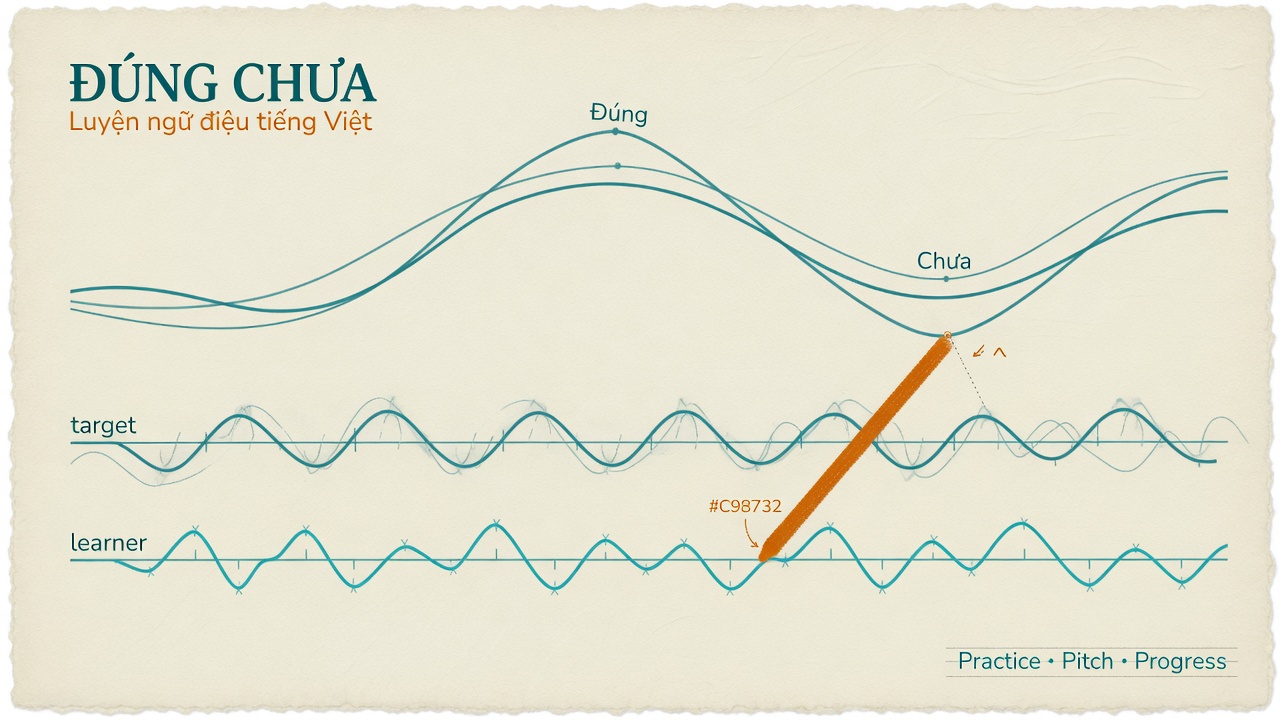
Why Vietnamese Tones Feel Hard Even When You Know the Words
Vocabulary can be solid while tones still fail. Recording check, one phrase, one correction.